

CRM and cashback
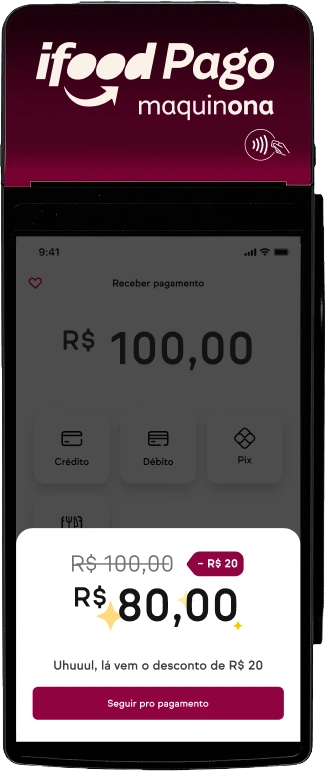
Identify customers at checkout, with their consent, and use offers to encourage return visits. Payment becomes a touchpoint for building the relationship.
IVAN FERNANDES / MAQUINONA CASE STUDY
I led and worked hands-on throughout the journey: from the first real processed to approximately R$300 million in monthly TPV. I helped shape the business model — P&L, pricing and viability — and build the product, platform and payments operation.
in total payment volume (TPV)
MEET THE PRODUCT
A look at the product connecting payments to the restaurant experience.
Interview with Bruno Henriques, COO of iFood and CEO of iFood Pago.
Watch on YouTube01 / THE PRODUCT THESIS
Three areas help explain Maquinona’s role in the restaurant ecosystem.
Identify customers at checkout, with their consent, and use offers to encourage return visits. Payment becomes a touchpoint for building the relationship.

Connect payments to restaurant POS systems and the restaurant journey, from ordering to management. 3S and Saipos extend this presence within the dine-in experience.
My team helped connect payments to restaurant POS systems. Those products were managed by other teams.

Connect sales and receivables data to financial services, improving business insight and opening up ways to finance growth.
Credit is part of the integrated financial services thesis. This connection does not mean the credit product was under my management.
IN THE CUSTOMER’S WORDS
02 / BUILDING THE BUSINESS
Bring iFood’s relationships and distribution to payments taking place inside restaurants.
Strategy and value propositionWork within the Jetski model: a lean, cross-functional team with autonomy over discovery, the business case, MVP and market fit testing.
Learning and go-to-marketConnect market sizing, pricing and P&L with payment terminals, partners, acquisition and operations. Make the proposition work end to end.
Product, operations and financial resultsDevelop activation, growth and ramp-up alongside reliability, efficiency and profitability.
Ongoing operations managementMY ROLE
I led PMs, Design and Growth and was involved from the start. I helped shape the business model — P&L, pricing, monetization and partnerships — while building the platform, restaurant experience and payments operation.
The work covered both early experimentation and the needs of a running payments operation: activating restaurants, improving the experience and pursuing efficiency and profitability.
03 / THE PAYMENTS PLATFORM
An executive overview of the capabilities involved, from restaurant onboarding to financial management.
The restaurant journey and relationship.
Payment acceptance, processing and settlement.
Pricing, P&L and connections to financial services.
Restaurant POS systems and payment partners.
This flow is a simplified view of capabilities. It is not a technical architecture diagram or a description of the sequence of all integrations.
04 / EVOLVING THE ECOSYSTEM
Maquinona and CRM connect to a broader iFood initiative: bringing together dining, operations and restaurant relationships.
Payments as a touchpoint for offers, cashback and return visits.
Restaurant management and dine-in operations connected to the ecosystem.
Expansion into customer relationships, discovery, offers and reservations.
These initiatives coexist. This is a strategic perspective, not a technical migration sequence. My contribution was to Maquinona and payment integration; I did not lead the restaurant POS products, acquisitions or Comer Fora.
05 / CHALLENGES & LESSONS

At launch, we bet on a customer profile that wasn’t the right fit for Maquinona. What we learned led us to rethink acquisition and reprioritize the product roadmap.
Validating the right customer is just as important as validating the solution.

In the early days, we operated in founder mode: we stored payment terminals at home, delivered them in person and took the first units to the post office ourselves. Our priority was getting the product into customers’ hands and learning from the operation.
Deciding what needs to be ready and what can be handled manually is part of building from scratch.

As we scaled, platform bottlenecks emerged and approval rates fell short of what we needed. We had to rethink monitoring and operations management to support the higher volume.
Growth also means changing how you operate — what worked at the start had to evolve.
Maquinona required us to connect the restaurant experience, platform, partners, logistics and P&L. Every product decision also had consequences for operations and financial results.
Leading that work means seeing the whole picture and owning the trade-offs across these areas.
REFERENCES